How we’re building an AI-first enterprise: Elastic’s internal playbook
Elastic's IT team shares our internal playbook on building an AI-first enterprise. Learn how we unified AI initiatives on a scalable platform to drive measurable ROI.


 Share on Twitter
Share on Twitter

 Share on LinkedIn
Share on LinkedIn

 Share on Facebook
Share on Facebook

 Share by Email
Share by Email

 Print this page
Print
What you'll get from this playbook
- How our IT team categorizes AI use cases into conversational AI and AI agents, and why that distinction matters
- Real performance metrics from our six internal AI applications, including $1.7 million in support cost avoidance and $372 million in AI-influenced pipeline
- The observability framework we use to monitor technical performance, contextual accuracy, and business impact across all AI applications
- Our architectural roadmap for moving from standalone AI apps to a unified, self-service agent hub built on a unified data foundation
What is an AI-first enterprise?
An AI-first enterprise is not defined by the number of AI tools it deploys. It is defined by its unified, governed, and scalable AI ecosystem that eliminates fragmentation. For Elastic, this means moving from isolated AI experiments to a single architecture built on a proprietary data foundation.
We’re building toward a unified agent hub, a centralized platform designed to provide employees with a single, consolidated channel to engage with all agents. This has required a cultural transformation, where leadership does not just sponsor AI adoption but embeds AI into the daily workflows of every employee. While working toward this long-term goal, we are also building and deploying internal AI experiences and workflows on the Elasticsearch Platform.
Our core AI use cases
Our approach to building an AI-first enterprise focuses on deploying several function-specific AI applications designed to tackle operational efficiency challenges. We categorize these solutions into two primary pillars:
Conversational AI, which surfaces relevant answers and insights from our unified data estate
AI agents, which go beyond information retrieval to execution by autonomously performing key actions within a workflow
Together, these approaches empower our workforce to eliminate friction in their day-to-day tasks and optimize operational efficiency at scale to drive measurable ROI.
Conversational AI
Our conversational AI applications are built on the Elasticsearch Platform, which lets us ground large language model (LLM) outputs in real-time, proprietary data to ensure relevance. These tools transform how we work by providing immediate, natural language responses to complex questions that can only be answered with internal knowledge, effectively reducing manual search time and accelerating decision-making.
| AI application | Business challenge | Success metric |
Elastic Support Assistant (internal) is an internal AI assistant built into our support portal that helps support engineers quickly answer customer queries and support internal teams. Engineers use it to build case summaries and knowledge drafts for new topics, simplifying workflows end to end. |
| Case deflections resulted in $1.7 million in cost avoidance in year one. A 23% improvement in MTFR led to a significant reduction in manual search and cognitive load for engineers. |
Elastic Support Assistant (external) is an external AI assistant that allows customers to get answers to queries in real time via our support portal. |
| Within the first six months, 5% of customers navigating to the Support Hub adopted the Support Assistant with a 30% return rate, driving consistent usage growth of 11% month-over-month. |
ElasticGPT is a secure, internal, RAG‑based generative AI application that answers common queries on company-wide information and processes. |
| Internal adoption surged with a 92% YOY increase in daily active users, saving approximately 1,300 workdays over the past year. |
Sales Assistant is a Salesforce‑embedded AI assistant that helps sales teams analyze accounts and opportunities via natural language conversations. |
| AI-influenced pipeline reached $372 million. Over 11,000 unique sessions saved 46 weeks of field service hours and reclaimed 88% of a sales FTEs’time. |
AI agents
AI agents at Elastic function as autonomous "executors" that use reasoning and predefined tools to navigate multistep workflows without constant human prompts. Built on the Elasticsearch Platform, these systems can independently plan tasks, synthesize disparate data sources, and trigger actions across internal and external platforms to solve complex business objectives.
| AI application | Business challenge | Outcome |
Threat Intelligence AI Assistant enables our security analysts to augment analyst expertise and reduce the manual workload of investigation and response. |
| Within the first six months, the team has recouped 75% of analysts’ time while increasing threat intelligence report output by 92%. |
RFP automation automatically drafts accurate, consistent responses to RFPs and questionnaires using Elastic’s approved knowledge. |
| By shifting from drafting to reviewing AI-generated outputs, teams complete RFPs faster and with much higher consistency. |
| IT Helpdesk Agent includes our IT laptop refresh agent, a solution that replaces manual forms with an ElasticGPT chat to verify eligibility and process laptop requests. |
| The laptop refresh process is now a five-minute automated chat that handles identity verification and compliance. |
How we monitor AI applications with observability to track KPIs
To understand the business value of our AI investments, we monitor our AI applications with Elastic Observability built on our Elasticsearch Platform. This comprehensive monitoring strategy allows us to track technical health, quality of user interactions, and user adoption.
Technical performance: By utilizing application performance monitoring (APM), we can track critical technical signals such as response times, LLM errors, search latency, and more to proactively:
Identify and resolve incidents before they impact the user
Detect anomalies and debug complex application issues faster
Ensure a seamless, low-latency experience for every query
Contextual accuracy: We evaluate the integrity of our AI’s output by extending Elastic Observability with context performance monitoring to track response accuracy, conversation quality, and direct feedback. With context performance monitoring, we use a centralized AI gateway to evaluate LLM traffic for sentiment and accuracy, subsequently indexing those insights into Elasticsearch to track and optimize the quality of model outputs. This data-driven approach enables us to:
Evaluate model performance to ensure AI applications are delivering accurate answers
Analyze user sentiment and satisfaction to guide iterative improvements on search relevance and performance
Business impact: Tracking adoption and usage enables our technology teams to understand the business value our AI applications are driving and future development and augmentation plans. We’re tracking business impact by:
Analyzing employee use of AI tools to measure time saved and calculate the direct financial return on our investments
Identifying frequent queries and high-value workflows to prioritize our engineering resources for the most impactful initiatives
Analyzing internal usage to help us fix bottlenecks and improve the user experience, building the trust necessary for widespread AI adoption
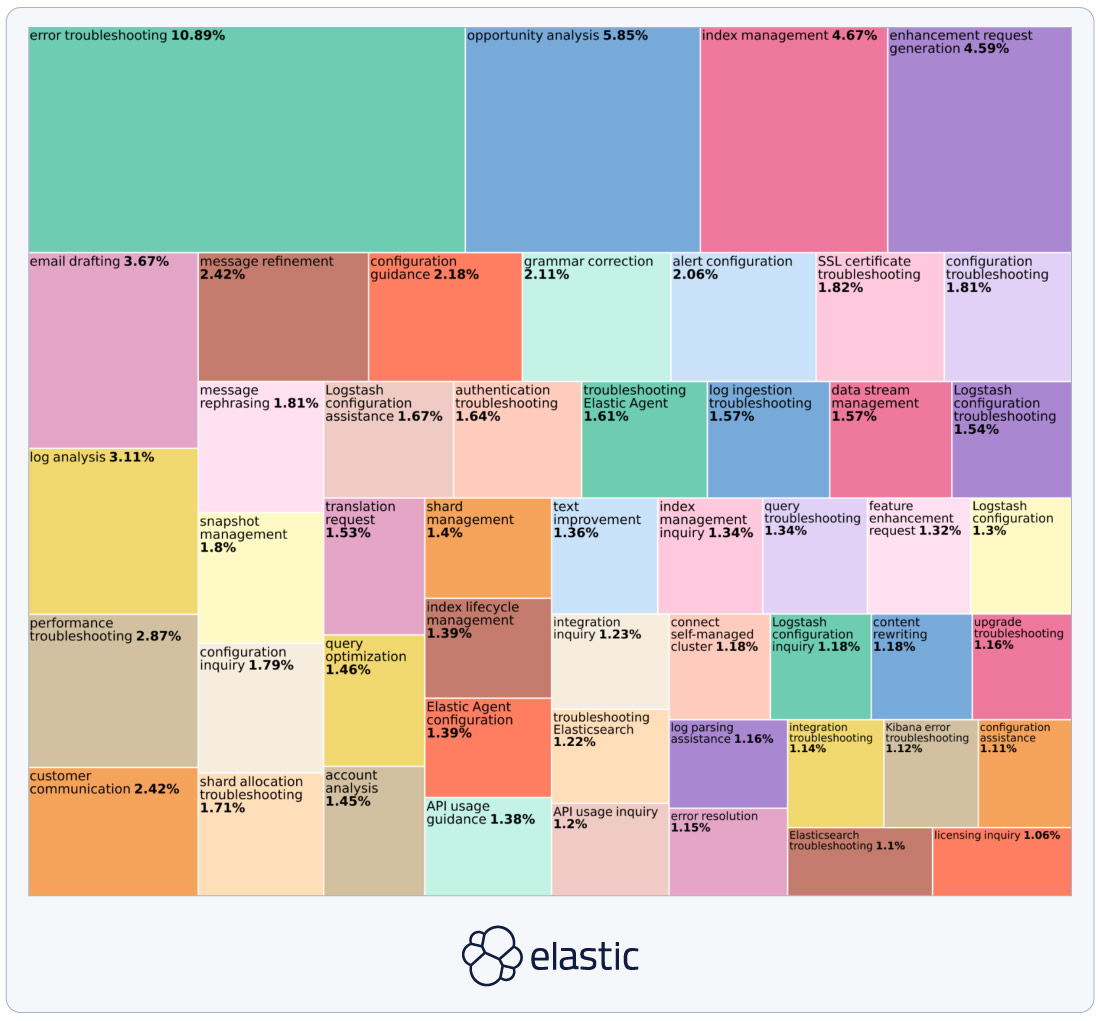
How we’re architecting the AI-first enterprise
At Elastic, we are transforming our business into an AI-first enterprise and the focus will be on creating a cohesive AI ecosystem. The backbone of an AI-first enterprise is the environment in which the models operate. We are focused on building a centralized, governed, and scalable architecture that eliminates fragmentation.
Core foundational components
- Strategic data foundation (faster data management): We will implement rigorous master data management (MDM) processes to certify global datasets. By establishing a standardized, AI-ready architecture, we ensure that every model is grounded in accurate, reliable corporate truth, effectively eliminating data silos.
Self-service AI agent infrastructure: To scale effectively, we are architecting a secure data layer and governance framework. This allows individual business units to rapidly deploy and manage their own AI agents while maintaining strict enterprise security and compliance.
Unified agent hub: We are evolving ElasticGPT into a central hub for Elastic-wide knowledge and workflows. This expands shared context, ensuring a "single source of truth" for every interaction.
Conversational analytics: We are moving beyond static dashboards by enabling high-accuracy conversational analytics. This allows stakeholders to extract actionable business intelligence and voice of the customer (VoC) insights directly through natural language questions.
- Cross-functional group: As agentic workflow matures and drives critical workflow in the company, we will set up a cross-functional group to view the impact to existing work and orchestrate change management across Elastic.
Upcoming AI use cases
Parallel to our transition to a centralized foundation, we continue to build new AI applications. We have outlined a few examples of the applications on our development roadmap.
| AI application | Business challenge | Expected outcome |
| Marketing qualified lead (MQL) Guidance is an agent that will surface context-aware “next best actions” directly on lead and contact records. |
| To measure success, we will monitor lead-to-opportunity conversion rates. |
| IT Helpdesk Agent is the next build of Helpdesk Agent, which will detect software access request issues/intents and automate the initiation and submission of the request. |
| Reduce administrative time spent on identifying and requesting software. |
| Leads Agent is an agent that automatically monitors, qualifies, enriches, and routes leads. |
| The primary success metric is a reduction in lead response time (speed to lead), to ensure that qualified prospects are engaged while their intent is at its highest. |
Building on the Elasticsearch Platform
At Elastic, our approach to customer first starts with customer zero. We build and deploy secure AI experiences and workflows on the Elasticsearch Platform with the following principles in mind:
Internal adoption for customer innovation: Rigorously validate and enhance our capabilities through internal implementation before deploying them for customer use.
Responsible AI by design: Trust, security, and accuracy aren't features we add later. They're embedded into every application from the start.
One platform, real outcomes: Run a centralized platform that allows us to eliminate tool sprawl and ship faster. Every use case is tied to specific business metrics before it goes live.
The Elasticsearch Platform makes it possible to develop conversational and AI agents on a unified, governed foundation. This ensures that every agent is integrated into a single, scalable architecture rather than a one-off app. With the platform, we’re able to feed data from across the enterprise into our AI models, no matter where the data lives. This ensures we’re getting accurate, relevant answers and actions.
As we work toward our goal of becoming an AI-first enterprise, we will continue to build AI applications through the lens of "customer zero," rigorously validating every secure, metric-driven workflow on our own platform to ensure our internal transformation drives proven, responsible innovation for our customers.
Share
- Share on Twitter
Share on Twitter
- Share on LinkedIn
Share on LinkedIn
- Share on Facebook
Share on Facebook
- Share by Email
Share by Email
- Print this page
Print