Audi Revolut F1® Team finds what matters fast with Elastic
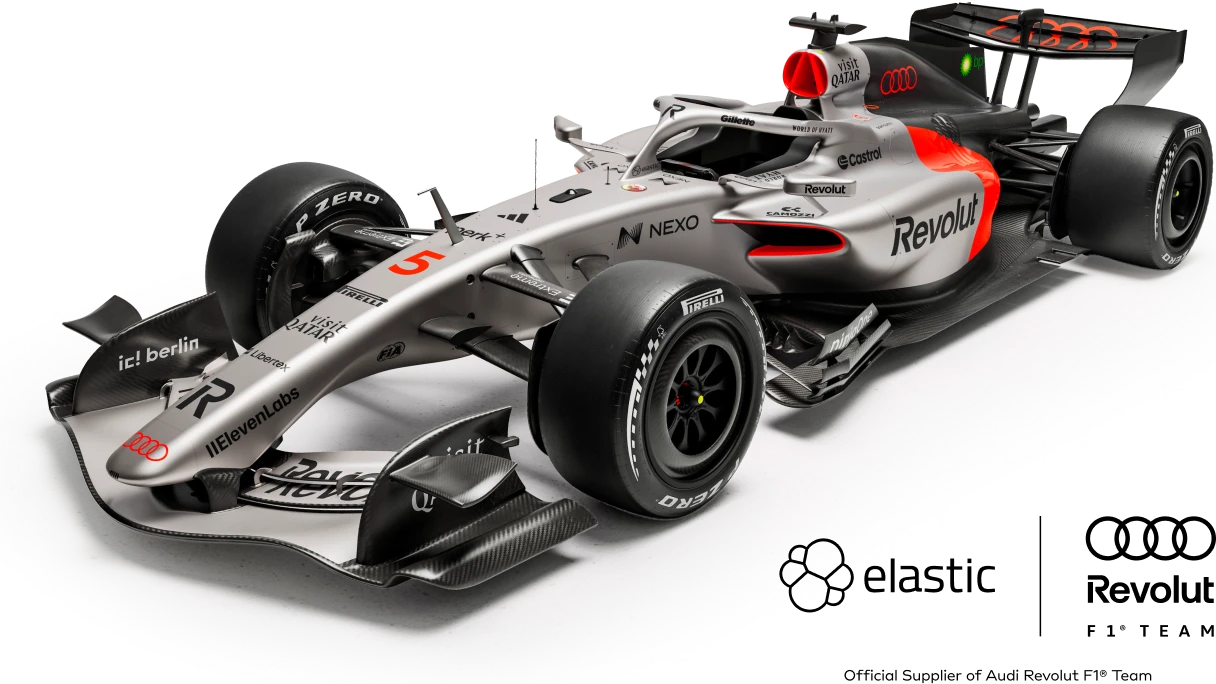
Elastic is now an Official Race Partner of Audi Revolut F1® Team. With Elastic, the team can search and observe the technology behind its engineering to find signals that matter and act faster.
Security, Observability, Search, and AI
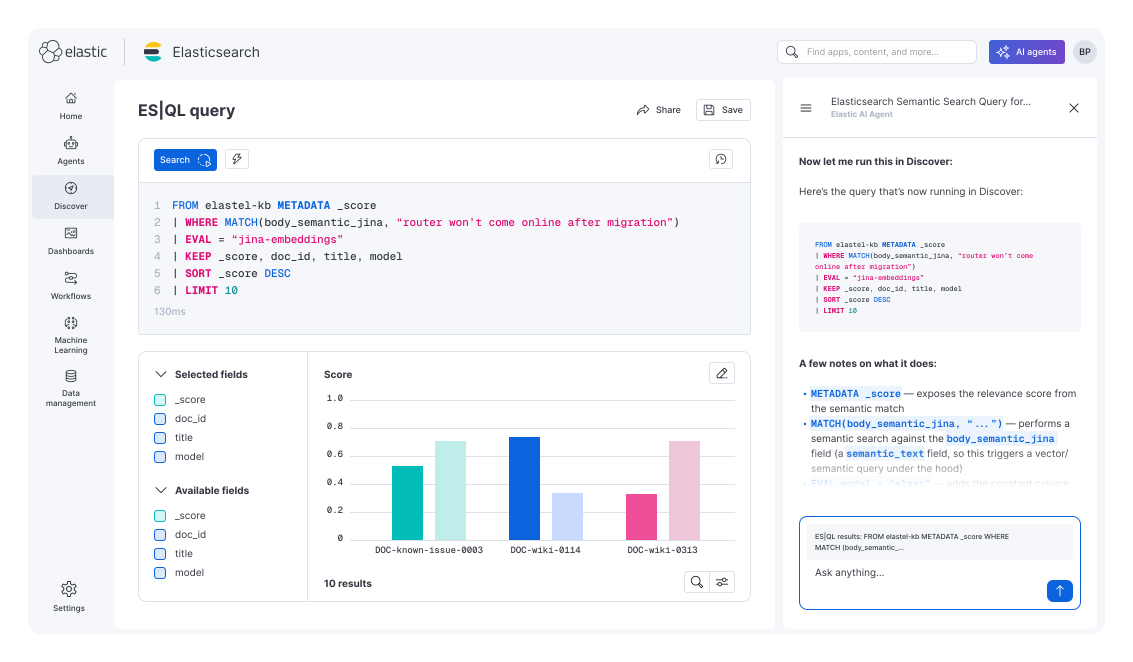
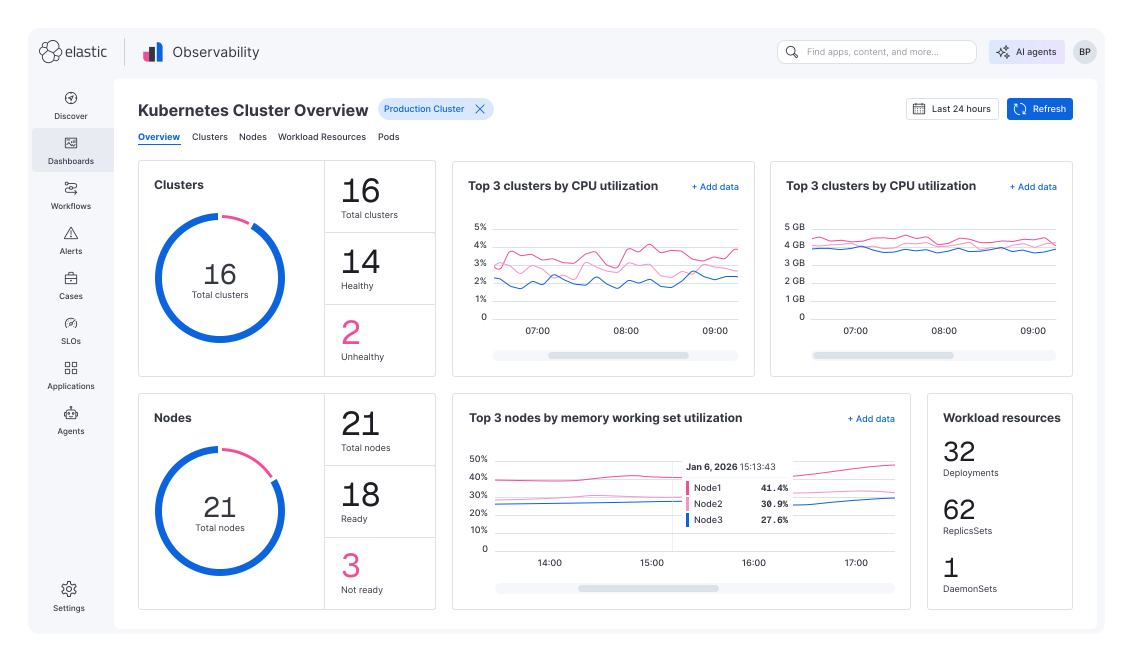
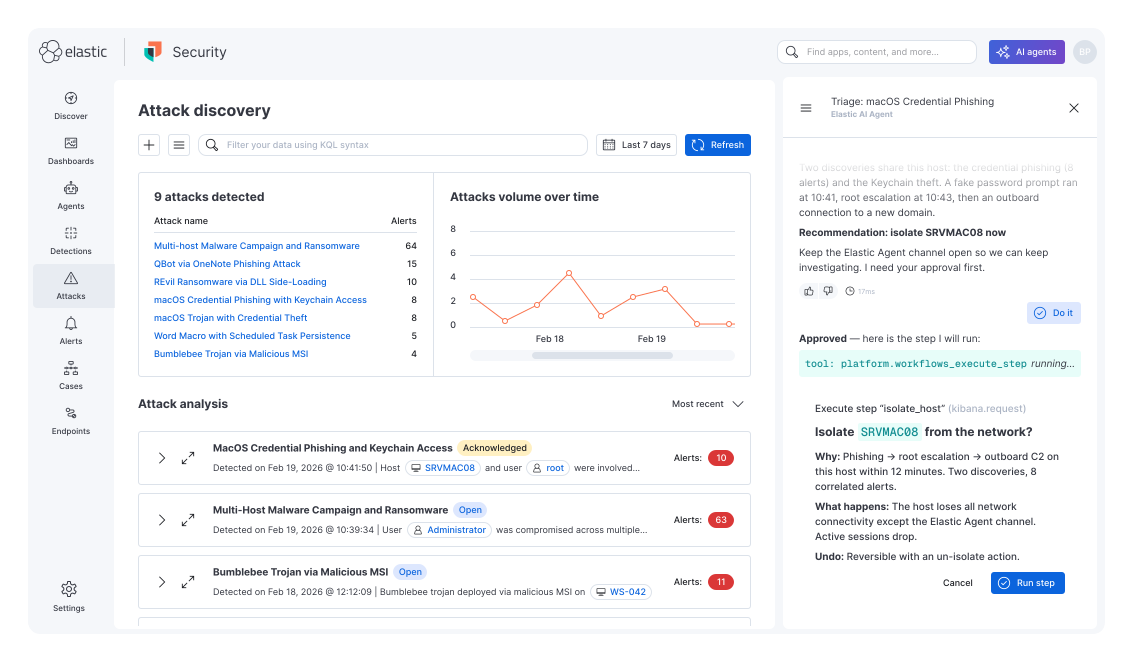
A SIEM ingests and stores your data to detect threats. Observability does the same to identify the root cause. Vector search retrieves the relevant passage. Agents search across your data to find the right answer. One efficient and performant search database powers each job.
The unified data platform for AI, context engineering, and so much more
From ingestion and storage to retrieval, visualization, and agentic orchestration, Elastic provides a unified data platform for development teams to ship at-scale context-driven AI applications, faster. Access best-in-class capabilities across the AI data stack — chunking, embedding models, hybrid retrieval, and reranking — all out of the box, instead of assembling and maintaining a pipeline of separate tools. Run the Elastic platform in any environment your organization requires: in the cloud, on-premises, or serverless.
- Queries up to 30x faster than Prometheus, Mimir
- #1 search engine per DB-Engines
- Vector memory cut ~95% with BBQ
- Filtered vector search up to 8x faster than OpenSearch
- Full-fidelity telemetry retention at half the cost
- Proficio found 34% faster investigations, $1 million in projected savings with automated triage
"Better, cheaper, faster"
Why 75% of the Fortune 100 choose Elastic

"Elastic supports our goal to have observability in a single pane of glass, including metrics, events, logs, the ability to capture 100% of application traces, and extensions to the Elastic Common Schema, which minimizes the log fields ingested by 60%."
"Elastic supports our goal to have observability in a single pane of glass, including metrics, events, logs, the ability to capture 100% of application traces, and extensions to the Elastic Common Schema, which minimizes the log fields ingested by 60%."
Joe Korchmar, Distinguished Engineer
60%
Reduces ingested log fields by 60%
100%
Captures 100% of application traces


Learn more about Elastic
What is Elastic?
Elastic is a technology company. Elastic builds the Elastic Stack — a suite of products that includes Elasticsearch (a distributed search and analytics engine), Kibana (a visualization and management UI), Logstash (a server-side data ingestion pipeline), Beats (lightweight data shippers), and Elastic Agent (a unified agent for logs, metrics, and security data). Elastic offers three solutions — Elasticsearch, Elastic Observability, and Elastic Security — all available via Elastic Cloud Serverless, Elastic Cloud Hosted, or self-managed deployment.
What is Elasticsearch?
Elasticsearch is the search database for AI, a distributed, RESTful search and analytics engine that can store every shape of data efficiently. Elasticsearch is the core component of the Elastic Stack and is built on Apache Lucene, an open source search library. Elasticsearch stores, indexes, and queries large volumes of structured and unstructured data over a RESTful HTTP API with support for full-text search, vector search, hybrid search, and real-time analytics at scale.
What is the difference between Elastic and Elasticsearch?
Elastic is the company and Elasticsearch is the search and analytics engine that Elastic builds. The Elastic Stack is the collective name for all Elastic products — Elasticsearch, Elastic Security, Elastic Observability, Jina AI, Kibana, Streams, Elastic Context Engine, Elastic Workflows, Logstash, Beats, and Elastic Agent — and Elastic the company is more than any single product in that stack. All Elastic Stack products are deployable via Elastic Cloud Serverless, Elastic Cloud Hosted, or self-managed on your own infrastructure.
What is a search database for AI?
Elasticsearch is the search database for AI. It can store every shape of data economically, including documents, vectors, logs, metrics, traces, images, geospatial, and more, in one engine. It can search data anywhere. It supports vector search over dense embeddings, semantic search using natural language processing, and retrieval augmented generation (RAG) pipelines that ground large language model (LLM) outputs in documents retrieved at inference time. Where a traditional database returns rows or keyword matches, a search database delivers ranked, preassembled context with relevance, reranking, and token budgets handled by the engine.
What solutions does Elastic offer?
Elastic offers three solutions: Elasticsearch for enterprise search, vector search, vector database, and RAG; Elastic Observability for logs, metrics, traces, and APM; and Elastic Security for SIEM, endpoint protection, and native automation. Kibana is the shared visualization and management UI across all solutions, and data is ingested via Elastic Agent, Beats, or Logstash. All solutions are available on Elastic Cloud Serverless, Elastic Cloud Hosted, and self-managed.
How does Elastic use AI?
Elasticsearch supports vector search over dense vector embeddings and semantic search, which uses natural language processing to retrieve results by meaning rather than exact keyword match. Elasticsearch supports hybrid search by combining BM25 keyword retrieval and vector retrieval with reranking. Elasticsearch also supports native machine learning model inference and retrieval augmented generation (RAG) pipelines that supply grounded context to LLMs at inference time. Overall, Elasticsearch serves as the retrieval and context layer for AI agents, handling knowledge base queries, memory retrieval, and tool calls with continuously updated data.
What makes Elastic different from other platforms?
The Elastic Stack unifies Elasticsearch, Elastic Observability, and Elastic Security in a single platform. Data indexed once powers search, monitoring, and threat detection without duplicating infrastructure. Elasticsearch is the search database for AI: it stores every data shape — structured, unstructured, vectors, and telemetry — in one engine; queries data in place across lakes, warehouses, and blob stores via ES|QL federation; and retrieves ranked, token-efficient context for models and agents. Elasticsearch ranks #1 among search engines and vector databases on DB-Engines and delivers filtered vector search up to 8x faster than OpenSearch.
Is Elasticsearch open source?
Elasticsearch is dual-licensed: the source code is released under both the AGPL v3 — an OSI-approved open source license — and the Elastic License 2.0, a source-available license that restricts specific commercial uses. Elasticsearch is built on Apache Lucene, which is Apache 2.0-licensed open source software. Most developers can use Elasticsearch under the AGPL at no cost; the Elastic License 2.0 applies to deployments that fall outside the AGPL's permitted use cases.
Is there a free trial?
Elastic Cloud offers a 14-day free trial with no credit card required. The trial includes access to both Elastic Cloud Serverless and Elastic Cloud Hosted, so you can evaluate both managed deployment models. Start your free trial.
How do I download Elastic?
Elastic Cloud is available as Elastic Cloud Serverless or Elastic Cloud Hosted and requires no local installation. Developers provision a managed cluster at elastic.co/cloud without downloading anything. For self-managed and on-premises deployments, Elasticsearch, Kibana, Elastic Agent, Logstash, and Beats are each available as packages, Docker images, and Kubernetes Helm charts from the Elastic downloads page. All self-managed products support Linux, macOS, Windows, Docker, and Kubernetes.