Open, agentic security operations platform
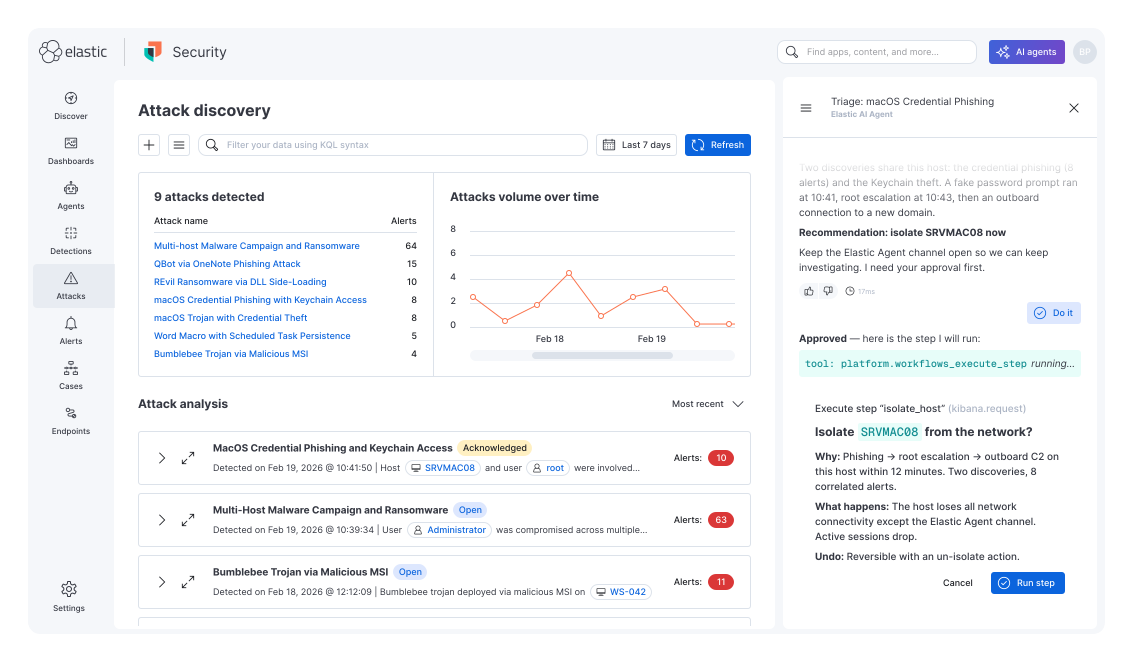
Elastic Security is the open, agentic security operations platform. Agents work the full lifecycle from ingestion through response and show you exactly how they got there. You decide what to automate with your choice of model, at your pace.
Built by security users, for security users
We've sat in the seat. We've worked the queue. We've chased the alerts. Elastic Security is the agentic SOC platform we wished we'd had.
Tool fragmentation is a nightmare
When detection, investigation, and response are spread across separate tools, context gets lost between them, and you lose precious time.
Everything requires an audit trail, especially agents
When it comes to explaining what happens and why to auditors, insurers, investors, and executives, you need AI that shows its work, with transparent and editable reasoning.
Waiting for data to rehydrate can’t be an option
During an incident, you need to search across months or years of data, quickly. You can’t afford to wait hours to bring archived data back online before you can query it.
Agents present two problems: volume and velocity
To defend against AI-powered threats like the Hugging Face incident, where response teams faced over 17,000 attacker actions grouped into over 6,000 clusters, teams need tools that can handle both volume and velocity.
What Elastic Security includes
One open, agentic security operations platform that offers SIEM, endpoint security, and native automation. A unified data model, one query language, zero context lost between tools.
AlertZero, the agentic layer of Elastic Security, is coming soon
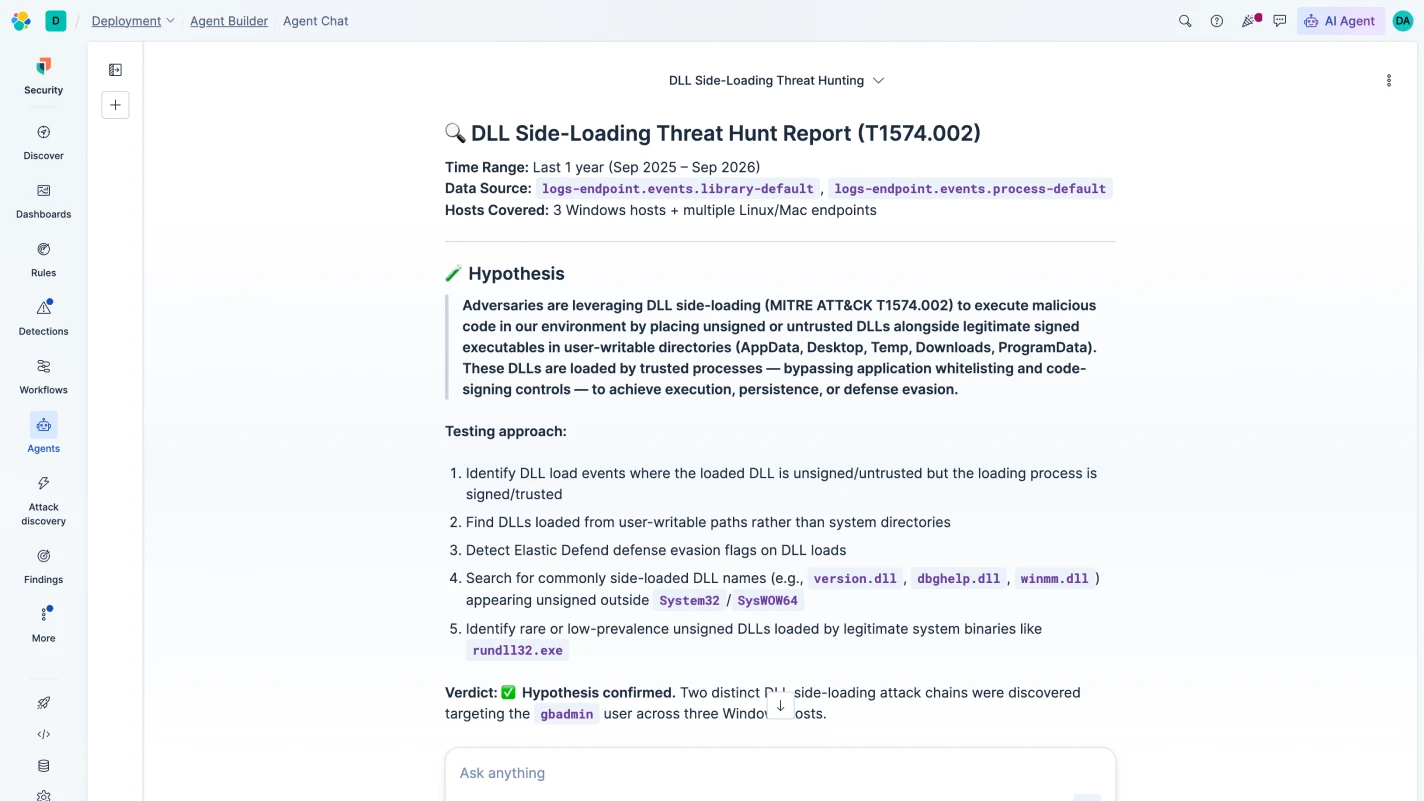
We can't wait to share what we've been building. AlertZero means every alert is answered, and every decision is yours. Agents across triage, investigation, and hunting propose evidence-backed actions.
AI-driven SIEM
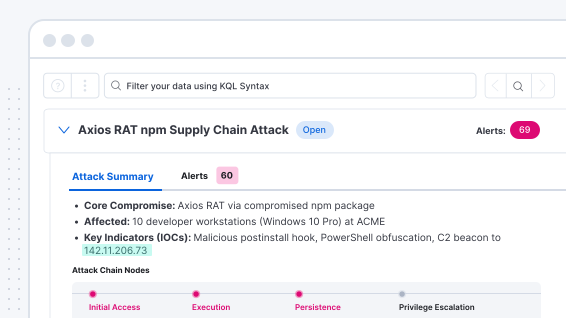
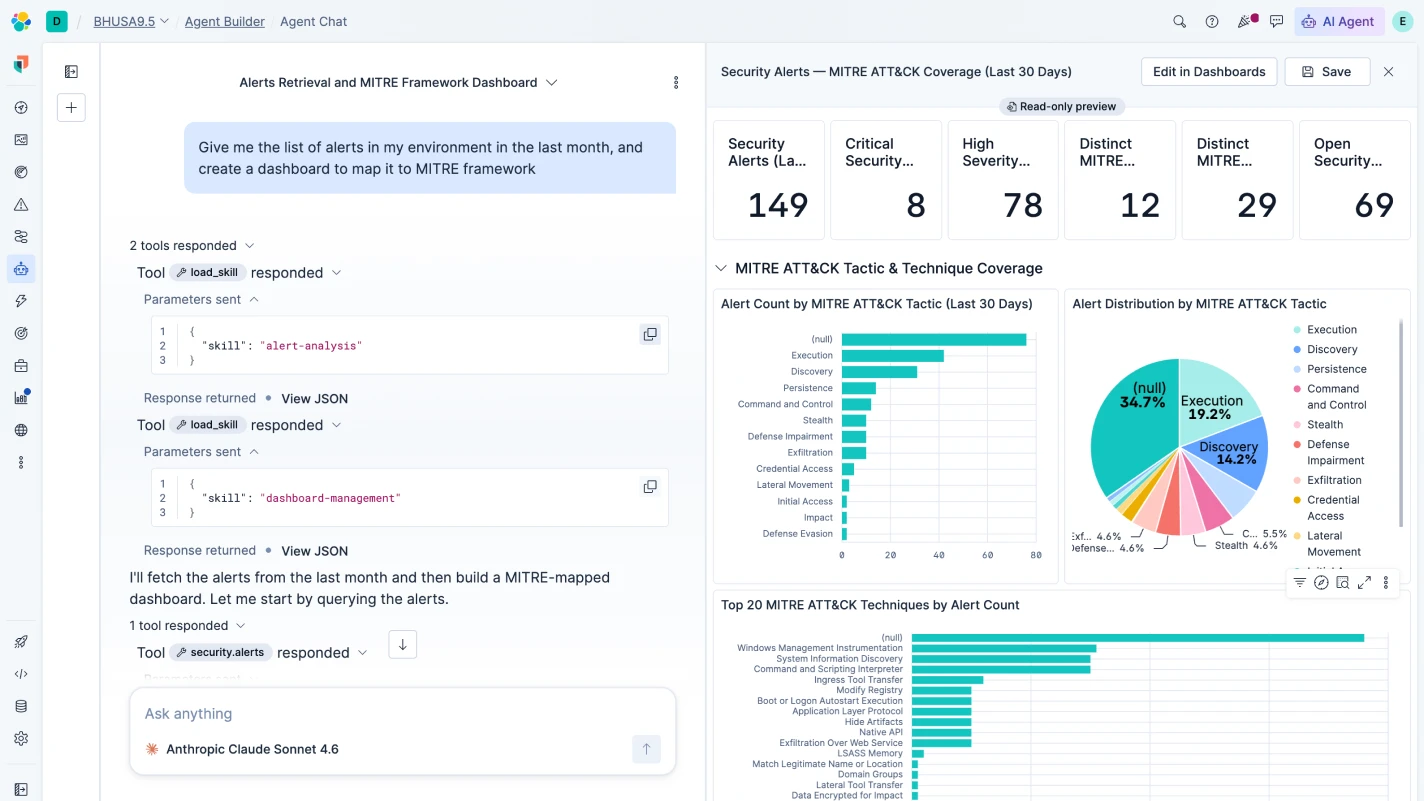
Let us chase down the alerts, find the correlations, and give you visibility into exactly what we found. You’ll get the full context to investigate and respond all in the same platform.
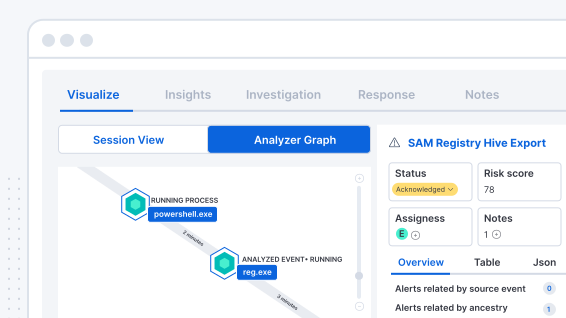
Native endpoint protection and response
Every threat stopped at the endpoint is an alert your team never has to triage. When something slips through, Elastic XDR and the agentic layer investigates and surfaces its findings for your approval.
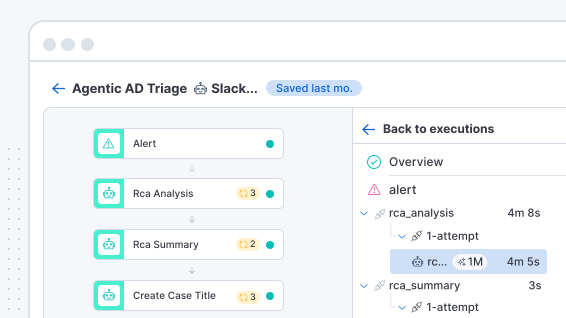
Built-in SOAR automation
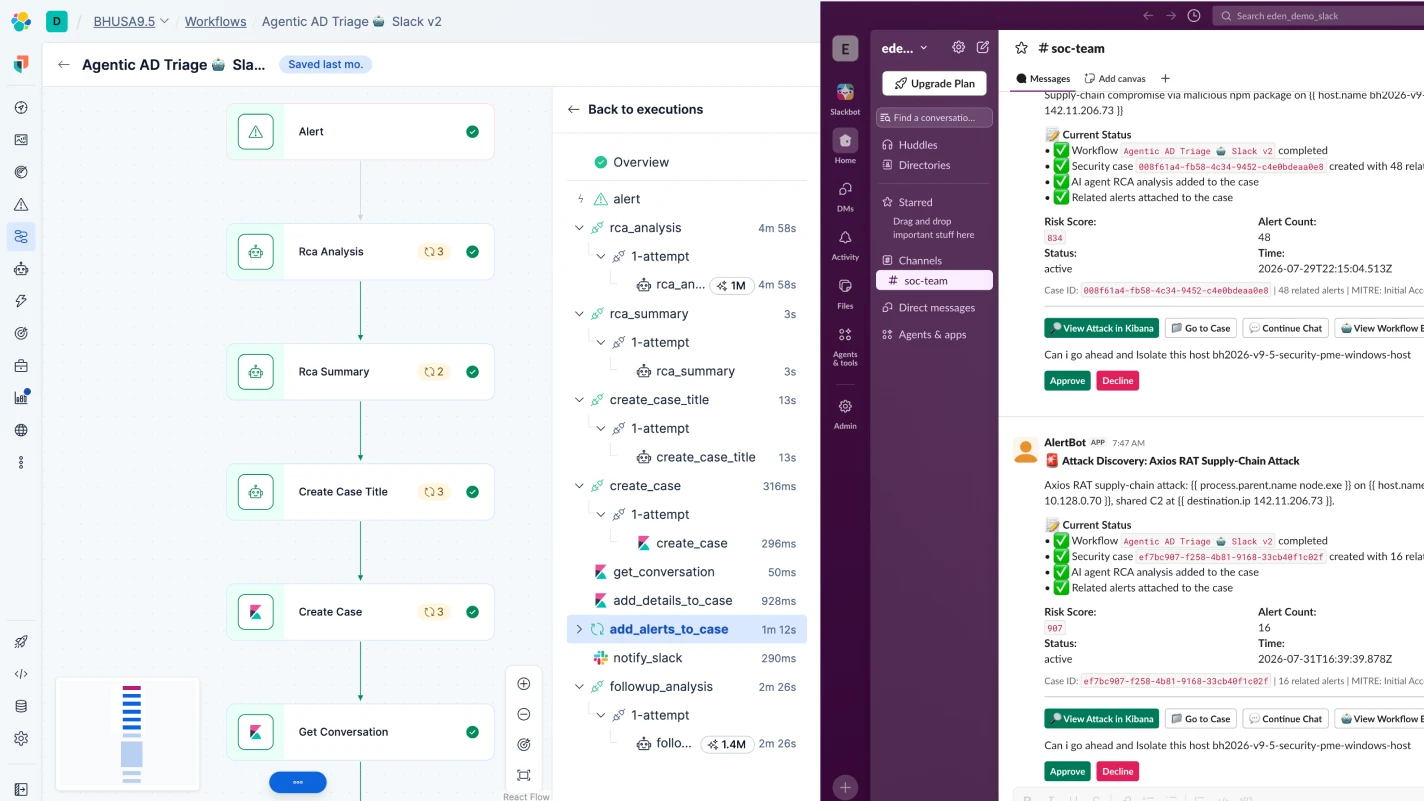
Let automation run the playbook so you can focus on the threats that need your expertise. When a step needs judgment, the workflow calls an agent to reason and surfaces the findings for your approval.
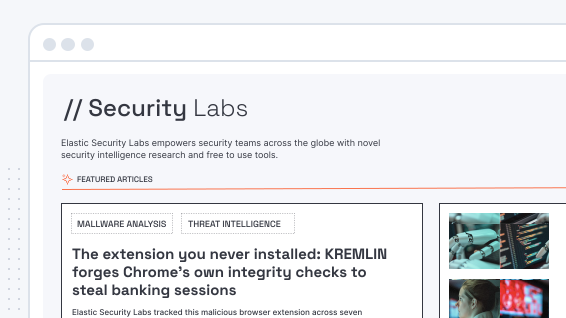
Threat research from Elastic Security Labs Threat Command
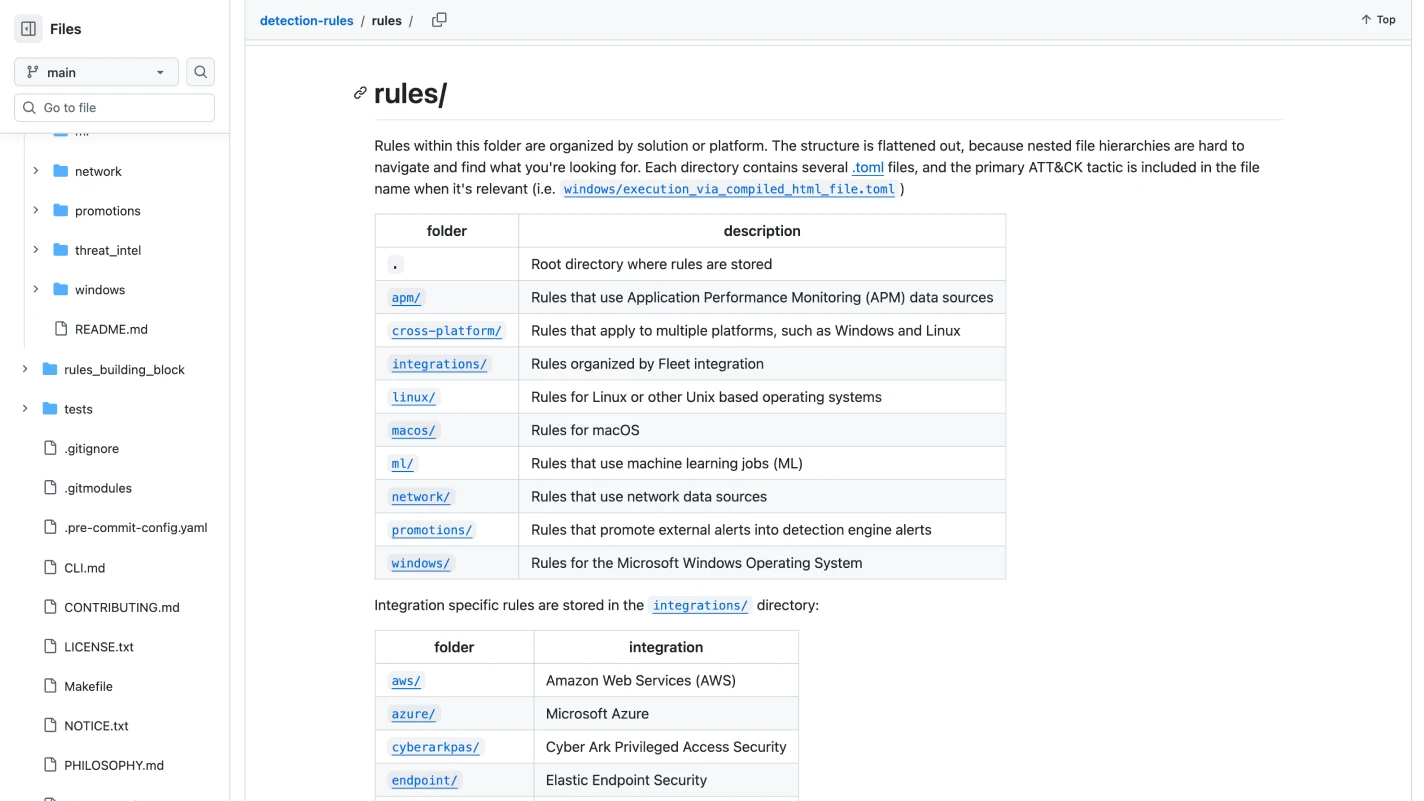
The research team tracking active threats in the wild writes your detection rules. Every rule is published openly on GitHub, so your team can read the logic, understand why it fires, and modify it if needed.
What you get with Elastic Security
Running on Elastic means spending less time on routine work, stopping more threats at the endpoint, and working with normalized data the moment you connect an integration.
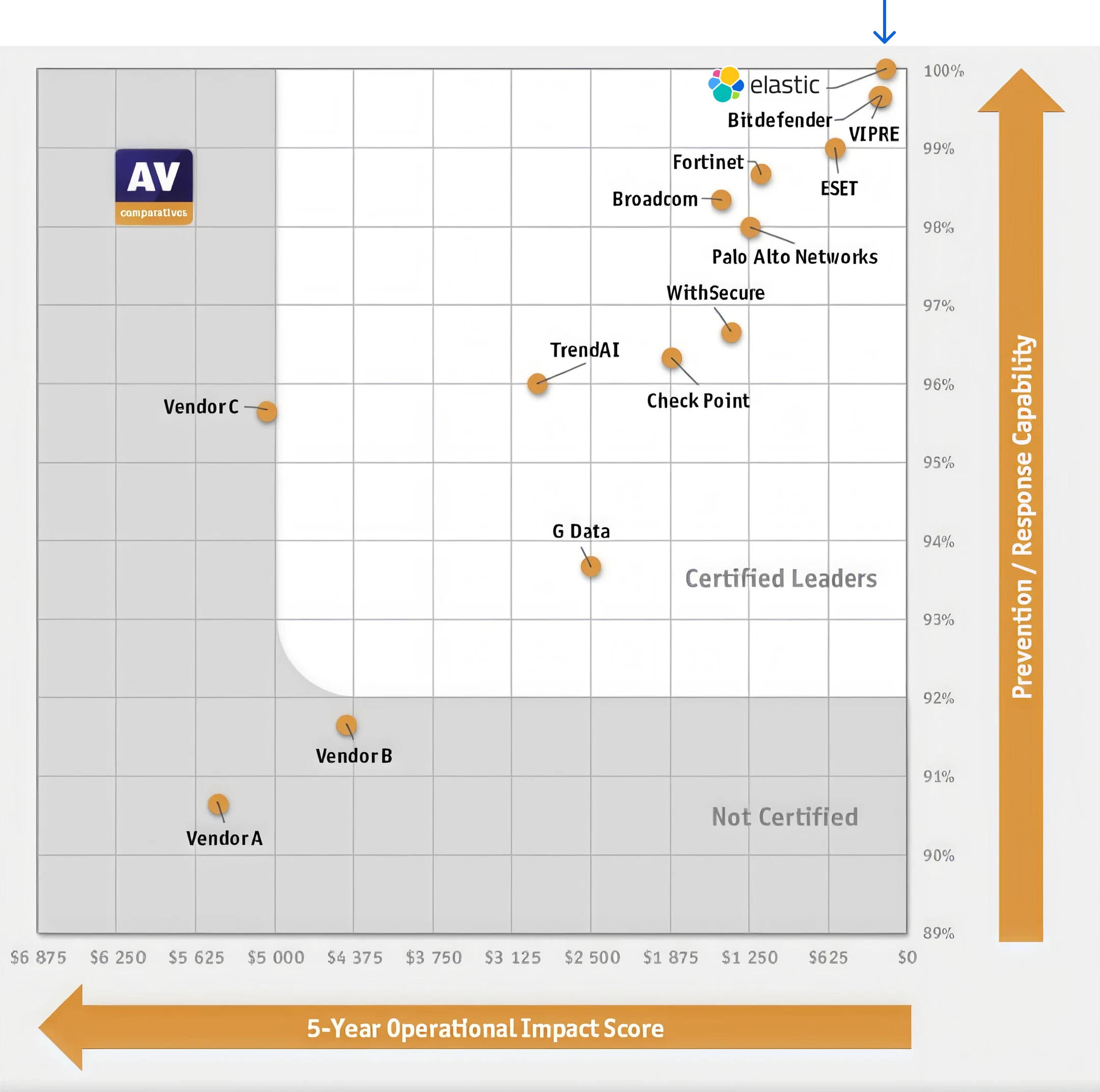
Leading endpoint protection efficacy
Elastic is at the top of this year's CyberRisk Quadrant with the only 100% protection scores, combined with the lowest modeled operational footprint of any tested product.
Free your team up for the work that needs them
Security teams using Elastic report 74% fewer hours spent on routine operations while covering a larger attack surface than before.

Open by design
Every integration normalizes your data and includes prebuilt dashboards, so your team can investigate a new source without writing parsers.

How AI agents and automation work across Elastic Security
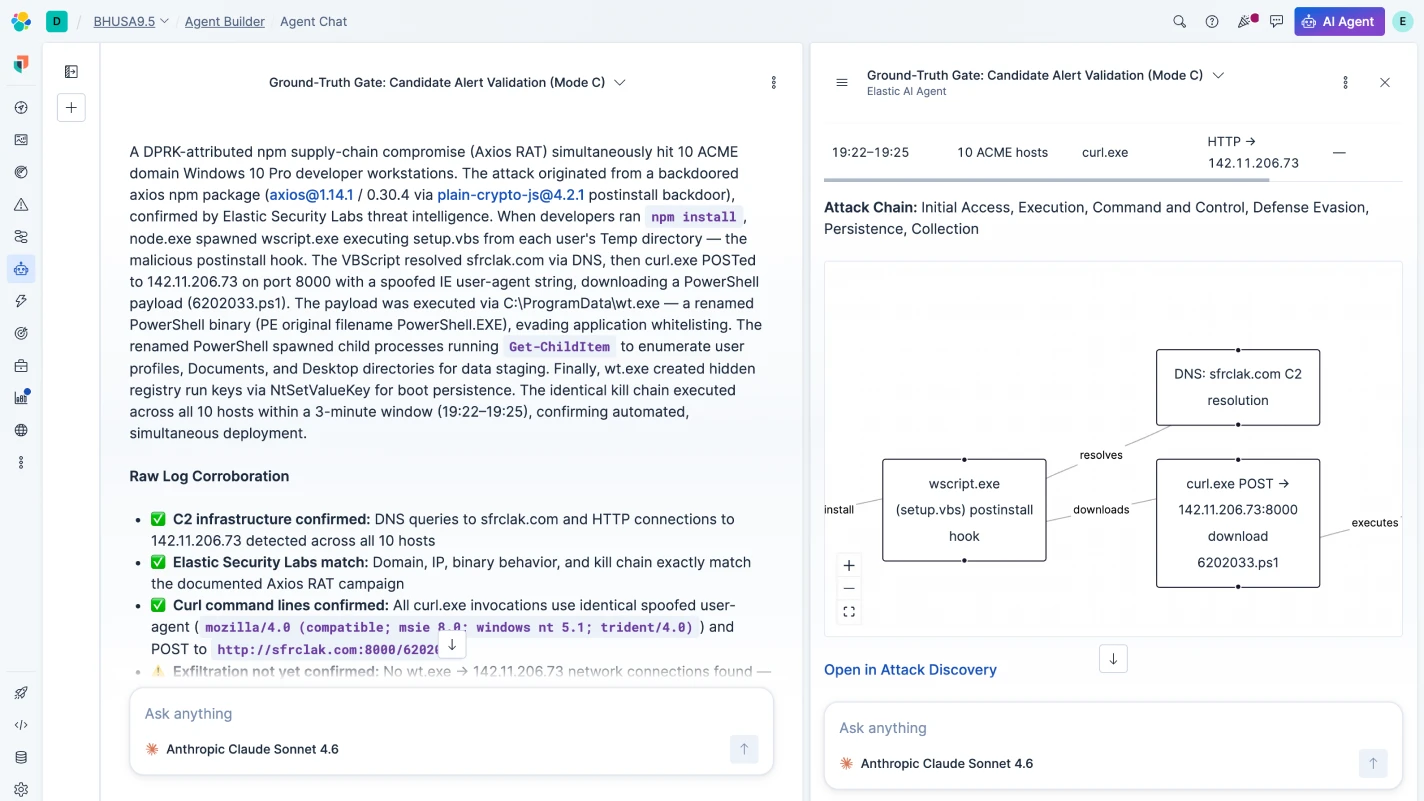
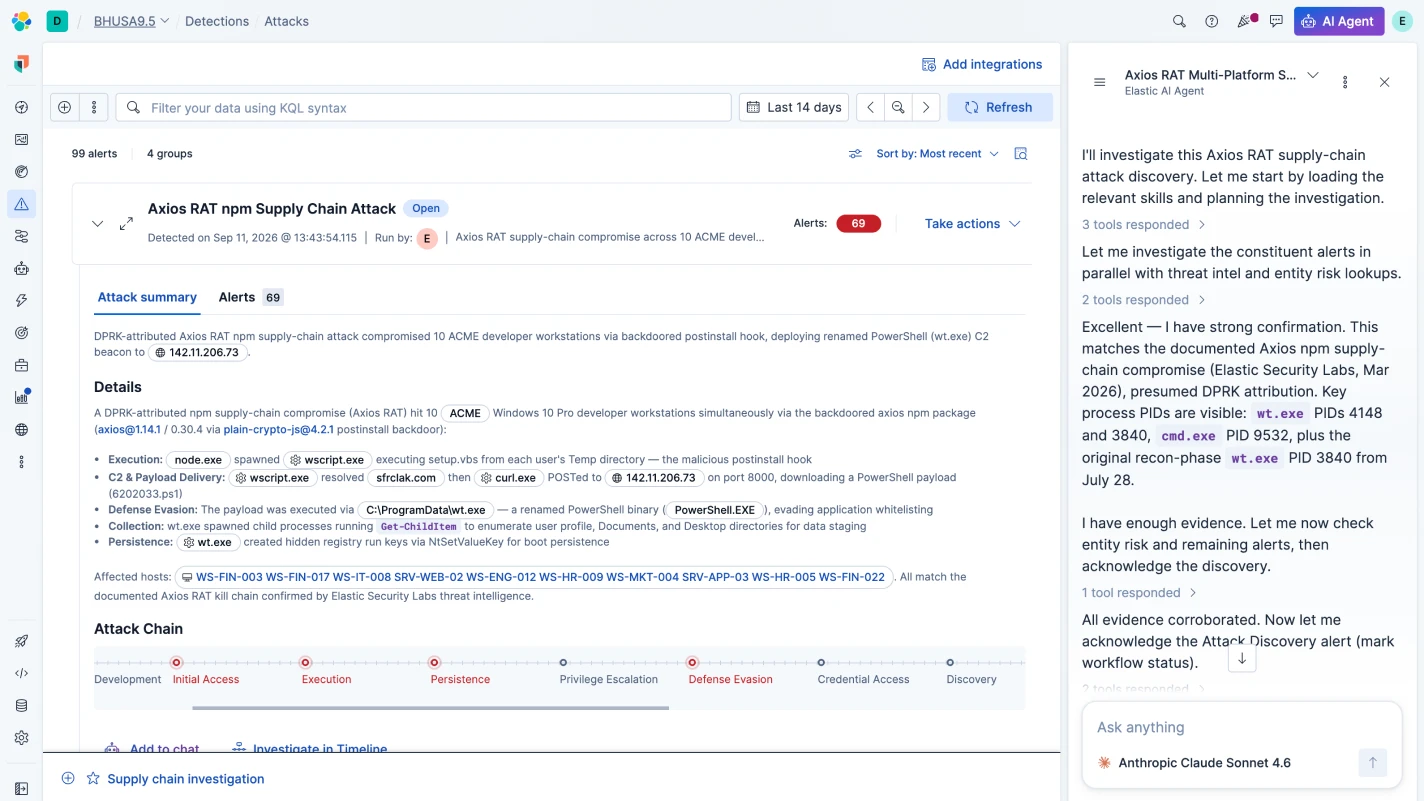
Elastic lets you decide what to automate and shows its work, so you can trust the results. See the reasoning, check the work, keep the receipts.
Attack Discovery correlates alerts into attack chains and investigates the activity behind them. You set the confidence threshold and can see exactly how the agent reached its conclusion.


Security experts running on Elastic

"Many security tools operate as black boxes: Data goes in, and alerts appear, but the reasoning behind them isn't always clear. With Elastic, we’re in full control."
"Many security tools operate as black boxes: Data goes in, and alerts appear, but the reasoning behind them isn't always clear. With Elastic, we’re in full control."
René Kalff, Technical Lead
5
years of archived data stays searchable
Join the chat, contribute to our repo, or even meet us IRL
Connect with Elastic Security's global community. We're on Slack, in GitHub, and hosting meetups near you.
Frequently asked questions
What is the agentic security operations platform?
Elastic is the open, agentic security operations platform. Agents work the full lifecycle from ingestion through response and show you exactly how they got there. You can use your data with the LLM of your choice, including frontier or on-premise models at your pace. Elastic Security lets you decide what to automate and shows its work and reasoning, so you can trust the results.
How is agentic security operations different from traditional SOC tools?
Traditional security tools surface alerts and wait for an analyst to act. An agentic platform investigates, correlates across your environment, and recommends a response with full reasoning shown at every step. Analysts approve the decisions that matter rather than chasing down the ones that don't, which means faster resolution with less manual work between an alert and a closed case.
Can Elastic Security replace multiple point solutions?
Yes, and if you're not quite ready for migration, Elastic Security has 400+ prebuilt integrations to support your existing toolset. The platform includes native SIEM, XDR, and automation capabilities, so it functions as a complete agentic security operations platform. When you do start your SIEM migration, Elastic's Automatic Migration will drastically speed up migrating your detection rules and dashboards.
How does Elastic Security use AI?
Elastic Security is built on a model-agnostic architecture, allowing customers to choose which model best suits their needs, whether it's Elastic Managed LLMs, OpenAI, Anthropic, Gemini, or on-premises open source models. Further, Elastic tests the performance of various LLMs for AI-driven features like Attack Discovery and sets the most performant model for that feature as the default. This LLM evaluation testing is available within our Elastic Security product documentation.
More specifically, Elastic uses Elastic Workflows for orchestration and Jina AI multimodal models for proprietary retrieval advantages across languages and unstructured data.
The same Elastic platform security teams use for detection is the platform AI engineering teams use to build agents, semantic search, and AI applications. That shared foundation means the AI reasoning in the SOC is grounded in real data context, not operating on a separate layer.
Does Elastic Security replace my current SIEM or XDR?
Yes. Elastic Security includes the capabilities you'd expect from a SIEM or XDR, but it's built as a single, agentic platform rather than a collection of products that need to be connected. Detection, investigation, response, and automation all run on the same data and infrastructure, so there's no handoff between tools and no context lost between them.
Is Elastic Security an open platform?
Yes. Elastic is open by architecture, not just marketing. It includes over 1,300 open and customizable detection rules published on GitHub, supports community standards like ECS and OCSF, and provides full transparency into the AI's logic, sources, and path. This "no black boxes" approach ensures defenders maintain full control over their data and rules.
How does Elastic Security pricing work?
Elastic Security is priced on compute and storage, not per endpoint. Elastic Defend is included in the platform, so endpoint protection isn't a separate line item. Historical data stays searchable without rehydration fees, so coverage decisions aren't driven by what it costs to keep data accessible. For pricing details specific to your environment, talk to our team.
Does Elastic Security work across cloud, on-premises, and air-gapped environments?
Yes. Elastic Security runs across cloud, on-premises, hybrid, and air-gapped environments without requiring data to move to a vendor cloud. You can detect and respond across your full environment from a single platform, regardless of where your data lives. For public sector organizations, critical infrastructure, and regulated industries with data residency or sovereignty requirements, that flexibility is built into the architecture.