Elastic named a Leader in the IDC MarketScape: Worldwide SIEM 2026 Vendor Assessment
Elastic Security is the agentic security operations platform — one platform for SIEM, XDR, and native automation.


 Share on Twitter
Share on Twitter

 Share on LinkedIn
Share on LinkedIn

 Share on Facebook
Share on Facebook

 Share by Email
Share by Email

 Print this page
Print
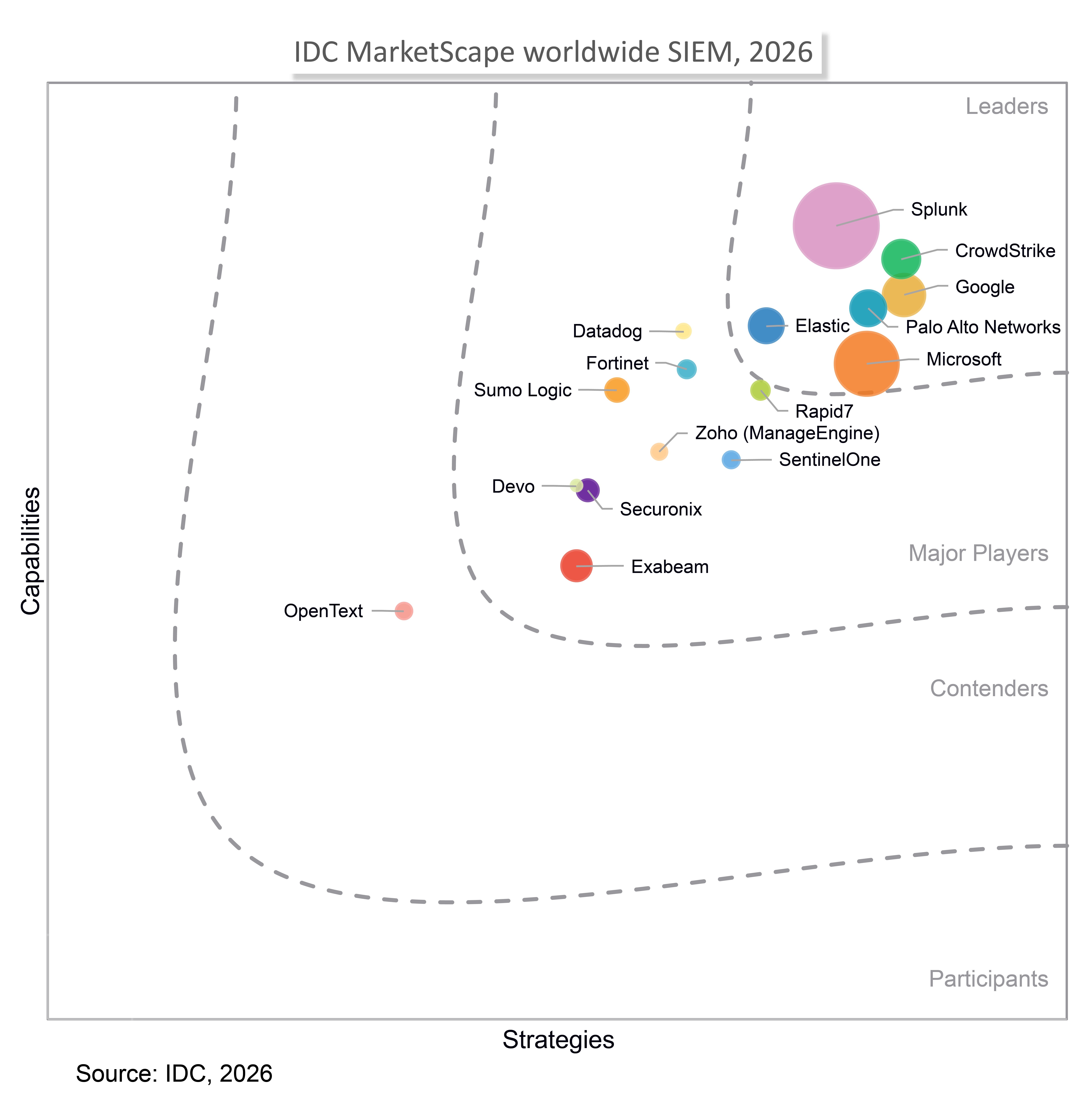
We are excited to share that Elastic has been named a Leader in the IDC MarketScape for Worldwide SIEM 2026 Vendor Assessment. We believe the report recognized Elastic Security’s architecture, deployment flexibility, detection engineering approach, and AI capabilities.
Security teams are facing a fundamentally different operating environment than they were just a few years ago. Threats are moving faster, data volumes continue to grow, and organizations are being asked to secure increasingly complex environments spanning cloud, on-premises, hybrid, and sovereign infrastructures. At the same time, many teams are looking to consolidate tools, reduce operational complexity, and adopt AI without sacrificing control over their data, models, or deployment choices.
We believe Elastic's placement as a Leader reflects the growing importance of a flexible, open, and unified approach to security operations.
According to the IDC MarketScape report, "Elastic Common Schema and the underlying Elasticsearch engine allow customers to query security and operational data using a single language. Customers report scaling log ingestion volumes by five times without re-architecting, and the same platform supports observability, extending value beyond the security team."
We believe this recognition highlights several areas where Elastic continues to differentiate, including unified security and operational analytics, deployment flexibility across cloud and self-managed environments, open detection engineering, and AI capabilities designed to give customers choice and control rather than lock them into a single model or operating approach.
Why organizations choose Elastic Security
Security teams are under pressure from adversaries that increasingly operate at machine speed. At the same time, many organizations are struggling with fragmented tools, disconnected workflows, rising telemetry volumes, and AI capabilities that lack transparency.
We believe modern security operations require a different approach: a unified platform that helps teams prevent, detect, investigate, and respond to threats without adding complexity, operational overhead, or additional costs.
Built on a data and AI platform
Security teams shouldn't have to choose between retaining data and controlling costs.
Elastic Security is built on Elasticsearch, the same platform organizations use to power observability, search, and AI applications at scale. Security telemetry, operational data, and AI-driven workflows all run on a common foundation, enabling teams to investigate threats using complete context rather than isolated signals.
According to the IDC MarketScape, customers reported scaling log ingestion volumes by five times without rearchitecting, and the same platform supports observability, extending value beyond the security team.
Your environment. Your requirements.
Security teams operate across cloud, on-premises, hybrid, and highly regulated environments. Elastic provides a consistent experience across self-managed, hosted, serverless, and disconnected deployments, allowing organizations to choose the operational model that best fits their business and regulatory requirements.
Whether supporting data sovereignty mandates, air-gapped environments, or public sector deployments, Elastic gives customers flexibility without sacrificing capabilities.
According to the IDC MarketScape, “Elastic Security operates with feature parity across self-managed, hosted, serverless, and disconnected deployments and supports federated cross-cluster search for organizations with data sovereignty requirements. The fit aligns with public sector, utility, and multinational buyers that SaaS-only products cannot serve directly.”
That includes our FedRAMP-authorized hosted SIEM-as-a-service platform, currently in production for the US Cybersecurity and Infrastructure Security Agency.
Security expertise you can see and verify
Many security platforms ask customers to trust detections, automation, and AI decisions without visibility into how they work.
Elastic takes a different approach.
Detection content is developed openly, aligned to Elastic Common Schema and OpenTelemetry conventions, and continuously updated by Elastic Security Labs. Analysts can inspect AI prompts, tool calls, reasoning traces, and responses, helping teams understand and validate how conclusions are reached.
Customers can also choose the models that best fit their needs rather than being locked into a single vendor-controlled AI stack.
Built to secure, not tax
Security teams shouldn't have to purchase separate products to achieve prevention, detection, investigation, and response.
Elastic combines SIEM, XDR, endpoint protection, AI-driven investigations, and native automation on a single platform.
Elastic Defend, our native EDR and the foundation of Elastic’s XDR capabilities, ships without per-endpoint fees, while Elastic Workflows, our native automation engine defined in YAML, runs natively in Elastic Security with direct access to your alerts, cases, and investigation data. Workflows can call agents as intelligent steps. Agents can invoke Workflows as tools to take action. For many SOCs, Elastic Workflows can replace a stand-alone SOAR license. Together, they help organizations reduce tool sprawl, eliminate operational friction, and accelerate response.
Security and observability on the same foundation
Security incidents rarely exist in isolation.
Understanding what happened often requires correlating security telemetry with application, infrastructure, and operational data. Because Elastic Security and Elastic Observability run on the same platform, teams can investigate threats and operational issues using the same data, analytics, and workflows.
We believe this shared foundation helps reduce tool fragmentation and enables faster investigations across increasingly complex environments.
Elastic Security is built on the same platform organizations already use for observability and log analytics. A security buyer choosing Elastic often extends a platform already in production, rather than adding a new one. Elastic Common Schema means security and operational data share a query language. An SRE investigating a service degradation and an analyst investigating a lateral movement alert are both querying the same platform. Correlating a spike in failed authentications with an upstream deployment is a query, not a project.
AI built on complete context
AI is only as effective as the context it can access.
Elastic's AI capabilities are built directly on the same data platform used for detection, investigation, and response. Rather than operating as a separate layer, AI can reason over security telemetry, operational data, detection content, cases, and historical context stored within Elastic.
Capabilities such as Attack Discovery, AI Assistant, Agent Builder, and Elastic Workflows help security teams reduce noise, accelerate investigations, and move from alert to response faster.
Attack Discovery applies LLM reasoning to correlate individual alerts into higher-order incidents, giving analysts an attack narrative rather than a queue. The goal isn't to remove the analyst from the loop; it's to make sure the analyst is looking at real incidents, not noise.
Elastic AI Assistant via Agent Builder supports natural language querying with the same reasoning trace described above. The transparency is intentional: Analysts can see exactly what the model did, which matters when you're making decisions about real threats. Agent Builder also lets security teams construct custom AI agents, skills, and tools, so the agentic workflows fit the SOC's actual processes rather than forcing processes to fit the vendor's workflow.
Looking ahead
The security landscape is changing rapidly as adversaries adopt AI and attack timelines continue to compress.
We're continuing to invest in agentic security operations, AI-driven investigations, native automation, open standards, and security workflows that help organizations move faster without sacrificing visibility or control.
We believe the future of security operations is a platform where AI handles investigation, correlation, and preparation while analysts provide judgment, verification, and oversight. That vision continues to guide our innovation across Elastic Security.
Read the excerpt
Read the IDC MarketScape report excerpt or explore how Elastic Security can support your security operations. Elastic Security is the agentic security operations platform — one platform for SIEM, XDR, and native automation, built on the data and AI platform that already runs across security, observability, and search.
The release and timing of any features or functionality described in this post remain at Elastic's sole discretion. Any features or functionality not currently available may not be delivered on time or at all.
In this blog post, we may have used or referred to third party generative AI tools, which are owned and operated by their respective owners. Elastic does not have any control over the third party tools and we have no responsibility or liability for their content, operation or use, nor for any loss or damage that may arise from your use of such tools. Please exercise caution when using AI tools with personal, sensitive or confidential information. Any data you submit may be used for AI training or other purposes. There is no guarantee that information you provide will be kept secure or confidential. You should familiarize yourself with the privacy practices and terms of use of any generative AI tools prior to use.
Elastic, Elasticsearch, and associated marks are trademarks, logos or registered trademarks of Elasticsearch N.V. in the United States and other countries. All other company and product names are trademarks, logos or registered trademarks of their respective owners.
Share
- Share on Twitter
Share on Twitter
- Share on LinkedIn
Share on LinkedIn
- Share on Facebook
Share on Facebook
- Share by Email
Share by Email
- Print this page
Print