What is an agentic security operations platform?
Security leaders are facing a generational platform decision. Before evaluating vendors, it's important to understand what the agentic model actually requires.
Definition
Agentic security operations platform, defined
An agentic security operations platform is a unified system in which human analysts retain final judgement, approval authority, and strategic direction while autonomous AI agents handle the full security lifecycle — from data ingestion and alert correlation through threat investigation and response execution.


The structural shift
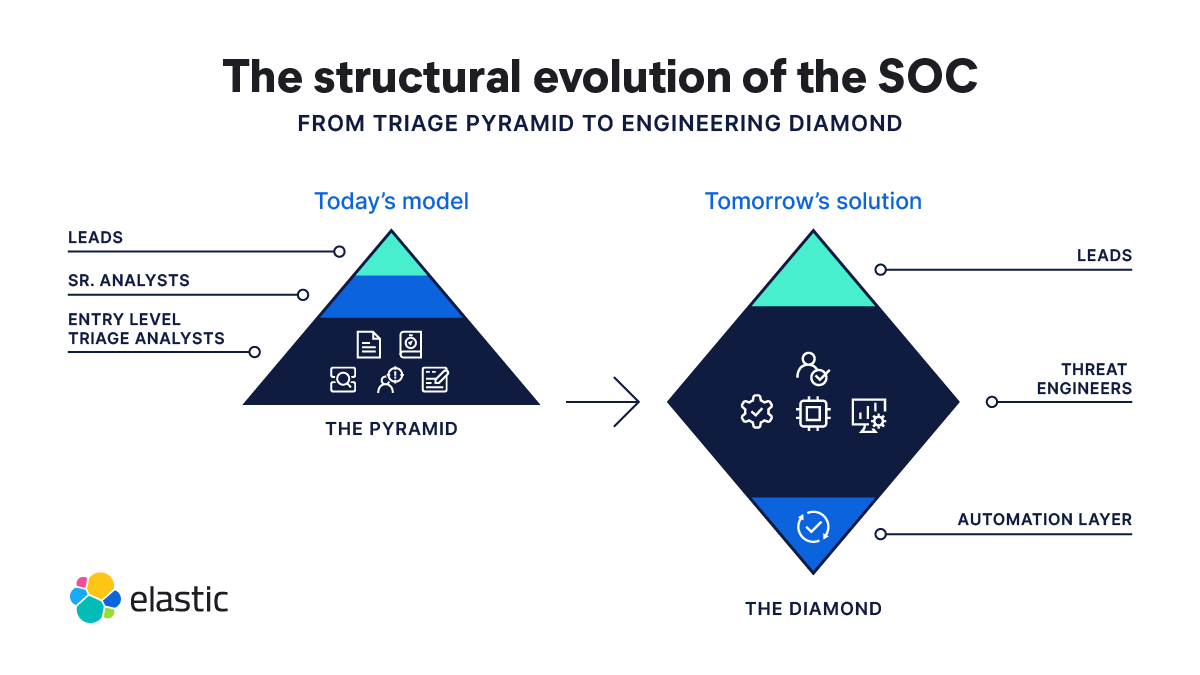
From triage pyramid to engineering diamond
As agents handle routine triage and enrichment, analysts move up — becoming threat engineers who direct strategy, tune agents, and focus on the threats that require human judgment.
The SOC gets faster, more accurate, and harder to breach.
What an agentic platform requires


Comparison
Agentic SOC vs. legacy architecture
The legacy model was not built for this moment. See how an agentic platform compares across the dimensions that matter most to a security leader evaluating direction.
Legacy SIEM
Next-gen XDR
Agentic SOC platform
Legacy SIEM
Next-gen XDR
Agentic SOC platform
Evaluation guide
Questions to ask before you commit to a platform
Not every platform claiming the agentic label was built for it. These questions help security leaders separate architectural reality from marketing positioning.


Frequently asked questions
Get answers to questions security leaders commonly ask when evaluating the agentic security operations model.
How is an agentic SOC different from a traditional SOC?
How is an agentic SOC different from a traditional SOC?
A traditional SOC relies on a pyramid of analysts manually triaging alerts and escalating to senior staff. An agentic SOC replaces the base of that pyramid with an automation layer. AI agents handle triage, enrichment, correlation, and initial investigation. Human analysts operate as threat engineers — directing strategy, approving responses, and focusing on the threats that require human judgment.
Is the human analyst removed from an agentic SOC?
Is the human analyst removed from an agentic SOC?
No — and this is the most important thing to understand about the model. The human analyst is not removed from the loop. They are moved to the top of it. The platform builds the case, stages the response, and presents its reasoning. The analyst validates the logic, judges the confidence level, and approves the action.
What does "human on the loop" mean in security operations?
What does "human on the loop" mean in security operations?
Human on the loop means the AI platform handles investigation, correlation, and response planning autonomously, but a human analyst reviews the complete case and approves every significant response before it executes. The analyst is not reviewing raw alerts — they are reviewing a fully assembled case with AI-generated reasoning they can validate, challenge, or override.
What capabilities does an agentic security operations platform require?
What capabilities does an agentic security operations platform require?
There are three integrated capability areas:
- Ingestion at scale: Universal data collection with no coverage gaps, automatic schema mapping, real-time historical access
- Reasoning at machine speed: AI grounded in your data with full transparency, composable skills, model agnosticism
- Prevention and response: native automation in the same platform as detection, with human approval gates before execution
How do you evaluate an agentic security operations platform?
How do you evaluate an agentic security operations platform?
Consider these key questions when evaluating an agentic security operations platform:
- Can the platform ingest all data sources without pricing-forced coverage gaps?
- Does it reason adaptively or execute prescripted playbooks?
- Can analysts see and validate every AI decision?
- Is automation native to the platform?
- Can historical data be queried in real time?
- Does it support model sovereignty for regulated or air-gapped environments?
- Is the platform open and auditable by design?